Over the past few months we have talked with a lot of nonprofit leaders about their boards. Executive directors, board chairs, chief of staff/operations person managing day to day work. The conversations were different in every detail and identical in one respect: everyone told us the same two things.
- The board is one of the most important assets the organization has.
- They are not getting the most out of it.
No one said this defensively. Most of them said it the way you'd admit you haven't been to the gym. It's true, everyone knows it, and there's never time to fix it.
People aren’t the problem
When I dug into why, the answers were rarely about the board members themselves. The people were good. What was missing was the machinery around them.
Board members genuinely want to help but don't know how. Nobody tells them where the organization is stuck this month or what a useful contribution would look like, so they show up, approve the minutes, and go home.
New members take the better part of a year before they can contribute in a real way (isn’t that crazy!), because the context they need is scattered across old packets, someone's inbox, and the memory of whoever has been there longest.
Executive directors and their staff spend days every cycle assembling packets, chasing RSVPs, tracking action items in a spreadsheet, and trying to remember when a decision was actually made. One ED told me she could not tell me, with confidence, which meeting a particular policy had been approved in. She had to go read three sets of minutes to find out.
And compliance sits on top of all of this: the conflict-of-interest forms, the document reviews, the things a funder or auditor will eventually ask about.
None of this is what these people signed up for. They started a nonprofit to work on a cause. Board management became a second job!
Why portals didn't fix it
The obvious answer is a board portal, and most of the organizations I spoke with had tried one. The problem is that portals only work if directors log in, and directors, who are volunteers with day jobs, mostly don't. So the portal becomes one more place staff maintain for an audience that isn't there.
That's the insight that shaped what we built. The work of running a board should not depend on anyone remembering to log in. It should come to people, in the channel they already use, with the context already attached. And it should leave a clear record of what was discussed, decided, and assigned, so that nobody has to reconstruct history from old PDFs.
What Karma Compass does
Karma Compass is a board assistant for nonprofits. It drafts the agenda and the board packet from what is still open on your board. It turns your notes, transcript, or recording into minutes. It collects RSVPs and votes over email, so directors never need an account or a password. And it follows up on what people agreed to do, on a schedule you choose.
Nothing becomes official until someone on your board approves it. The agents prepare the work; your chair, secretary, and executive director make the decisions.
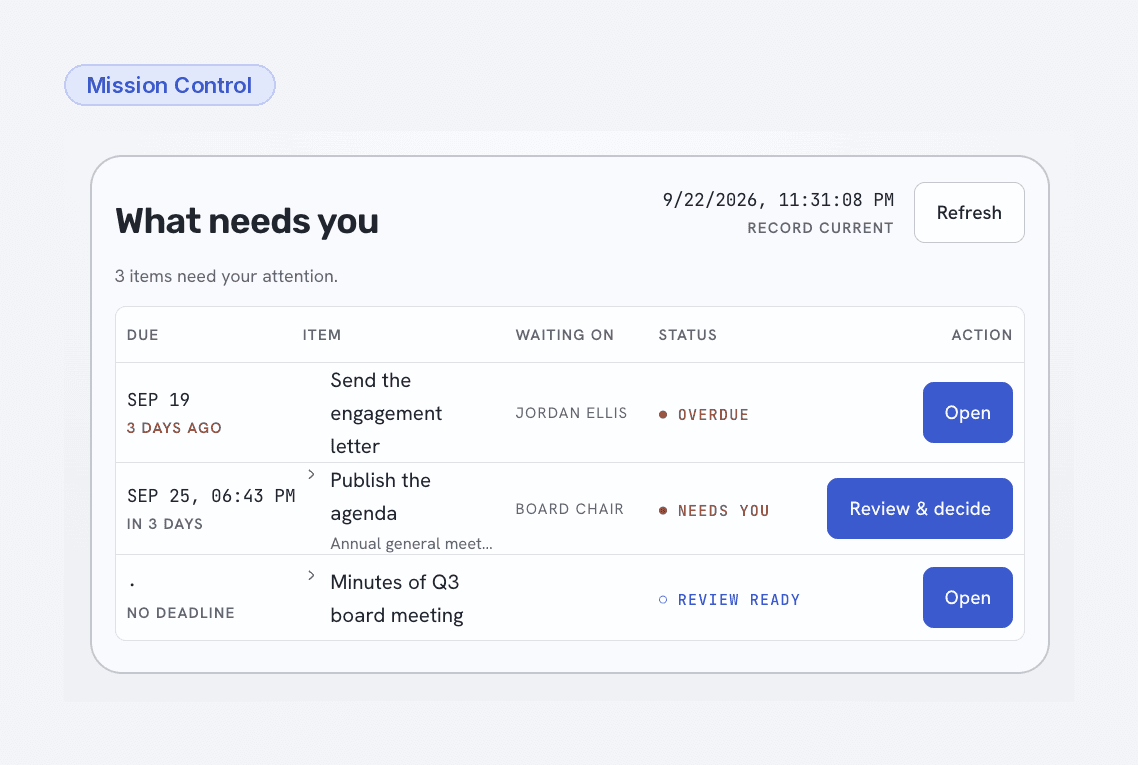
When staff sign in, they land in Mission Control: one list of what needs a human today, soonest first. Approvals waiting on a decision, action items that are overdue, minutes ready for review. Each row opens the place where you deal with it.
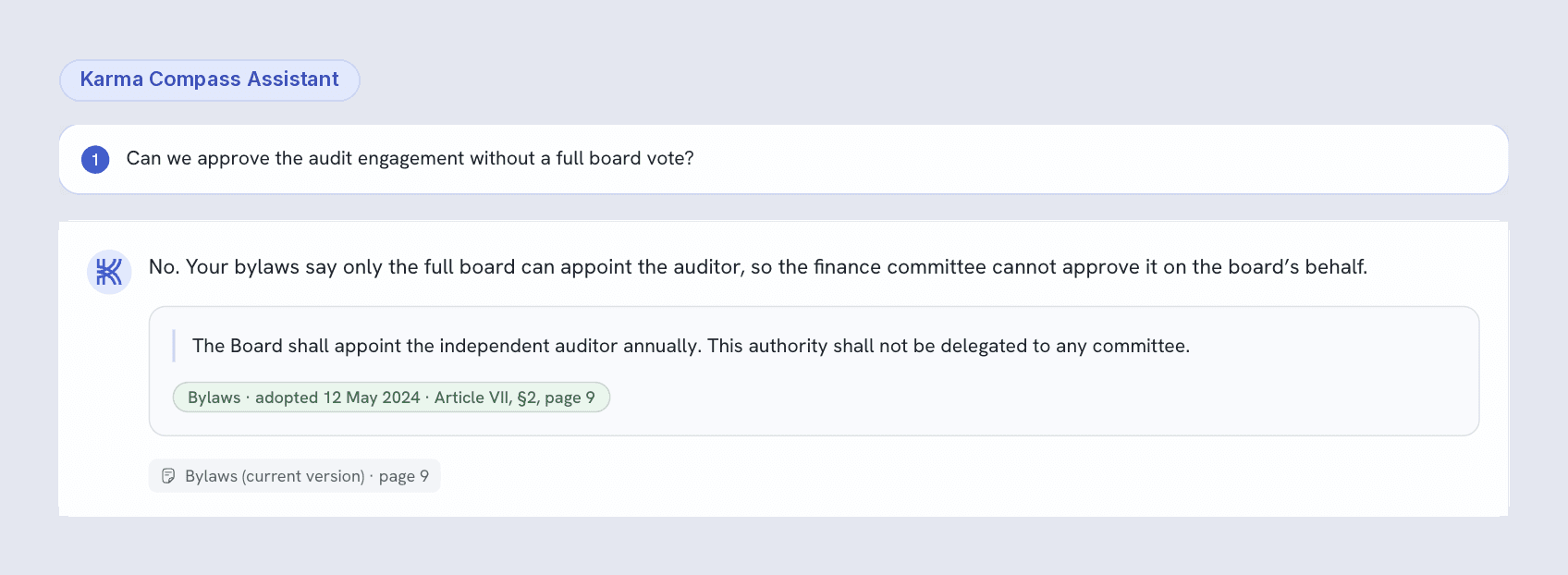
And when someone asks a question like "can the finance committee approve the audit engagement on its own?", Compass answers from your own bylaws, policies, and past minutes, and shows the passage it used, with the document and page. If your documents don't cover the question, it says so instead of guessing. That is the answer to the ED who had to read three sets of minutes.
Where to start
Karma Compass is live today at compass.karmahq.org. Setup starts with what you already have: your board roster, your bylaws, your last set of minutes, and your next meeting date. Every new organization starts on Karma Compass Pro, free for two weeks, and the plan after that is a flat $99 a month. We also have a generous free plan.
If you run a nonprofit, or sit on the board of one, I'd like to hear whether any of this matches what you've seen. You can reach me at mahesh@karmahq.org.
Get posts like this by email
New posts, product updates, and what we learn about running boards well.